Getting Fun Done (GFD): The Toilet Paper Game- How To Get Your Kids To Help

When I was a kid we had a tradition of eating formal family meals for Saturday lunch in the dining room. My mother wanted to get the kids to help clear the table after a meal. Her solution, we play a game similar to 20 questions. A person goes to the kitchen with something from the table (a water pitcher for example) and puts it away (or on the counter at least). Before the person returned the people at the table would pick a secret word. When the person returned, he would pick a person to give him a clue or ask someone a question. We would keep going around the table until he (or she) correctly guessed the secret word. This would continue until we cleared the table.

This isn’t the most efficient way to clear a table of course. It took a while to clear of the table while playing but we weren’t really cleaning the table we were having fun playing the game. Often we played even after the table was all clear. This is one of the lasting memories of fun from my childhood.

So how do you get your kids to help? Make it fun. Make it a game.

Now when I want to get my kids to help clear the table (when there is time) and have some fun we also play this game. It works well when they have friends over also.

So how did the game become known as “The Toilet Paper Game”? Let’s just say once the secret word was “toilet paper” and lots of laughs ensued.

It’s appropriate to post this today on my mother’s birthday as she’s always been creative getting us kids to be more productive and having fun. Happy Birthday Mom!

Spread The Word- Machines Rule the Successful World

Recently this blog was featured on Lifehack’s article Readers Recommend: 15 More Productivity Blogs You Probably Never Heard Of. Although it was nice to be recognized, next time I would rather it be for “15 Best Productivity Blogs You’ve Probably Heard Of”.

Usually when you read a website you passively take in the lessons and hopefully some of it sticks. Today we will not just sit back and read about how building a machine can help you, we will experience it in action. I’ve written about how Skellie used her machine to launch a new blog to 1000 subscribers. Today I want to take my humble but awesome machine of  subscribers (you can get the blog delivered to you) and repeat site visitors and use it to succeed. If you like this site please spread the word. Tell your friends (you want them to succeed), your family (because you love them) and to your coworkers (they help you succeed).

Success Making Machine– A life management system that takes you beyond productivity and tricks to build a machine to help you succeed.

Never Work a Day in Your Life, Have Your Day Work For You.

Remember the site slogan, “Never Work a Day in Your Life, Have Your Day Work For You.” You all are now part of my machine.

I will recognize the most innovative people– just let me know how you helped spread the word.

The additional lesson here is don’t be afraid to ask for favors. I’ll let you know how this experiment goes.

How To Make Water Warm or The Other Way to Be Successful

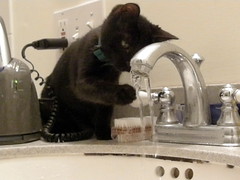
080130 moxie sinkThis morning my five year old was trying to get the tap water to come out warm. He kept fiddling with the hot valve to try to get it just right. This was a time consuming process. A simpler solution of course is to use the cold valve (which I explained to him).

Often when we are solving a problem we concentrate exclusively on one tactic- missing a parallel tactic. Here’s three examples where looking at alternative solutions can speed up success:

Stay fit

Most people think about exercise when it comes time to stay fit. How about just eating less, a little less at a time.

Balance Budget

There are two ways to balance your out of wach budget: spend less and make more. Most people only look to one or the other- they should use both.

Career Advancement

There are two ways to achieve career advancement: promotions within or moving to a new company. Most people pick one tactic or the other. Some people always look to move on. “They just don’t appreciate me here” they say. But the pattern repeats itself at each job they take. They should consider trying to make their current company appreciate them and realize what their contribution is. Sometimes just asking for a promotion is enough to get the ball rolling. Try to get concrete steps on what the criteria for the promotion is.

Then there are others who just stay at a company for a long time waiting for their promotion. They have been promised a promotion or were told “soon’ but the promotion never comes. This may be because the company doesn’t adequately value your contribution and perhaps never will. It may be time to look externally. Start feeling around for a new job.

In any task your doing, think about other approaches. That may give you an easier way to acheive your goal.

What are your challenges?

photo credit: Dan4th

Rich Lessons From David in Diamondonia

I recently wrote about a tale “David in Diamondonia” I heard when I was a child that still resonates with me years later. There are numerous lessons that can be learned from this simple story.

Here’s a few and then I’ll tell you about the one I thought of now decades later- that’s even more powerful than all of these.

  • Know your goal. While working hard to get were you want you should keep in mind the goal. Often while working we forget the main goals and principles that cause us working so hard. (Martin Wildam)
  • Think ahead. Instead of bringing money he should have brought candles – sell them for expensive and buy diamonds for those. (Martin Wildam)
  • Value is a completely relative thing. It depends on: Who, Where, When (Martin Wildam)
  • Give people what they want, not what you want.
  • Trust but verify. Even the best and brightest aren’t always doing the best thing. They need to have some monitoring.
  • Small gestures (of the right kind) can be worth much e.g. the diamond in his shoe.

But the lesson I recently thought of is that Diamonds (and money) are just our candle. Diamonds don’t do anything- they don’t make people happy, healthy or successful. Think about it- a diamond is just a glittery rock. Similarly dollars are just paper. Diamondonians aren’t stupider than us, we just have different value systems so we chase diamonds instead of candles. Because our world places such a high value on “diamonds”(material objects) we constantly strive for diamonds when we may be missing something more valuable. Certainly money or candles have value and are needed but at the end of the day they are only there to get you to your goal- they aren’t a goal.

Building Habits: How a Green Lawn Can Tell You If I’m Running

The best way to expand habits is to build on an existing habit and make it part of the habit.

Here’s my recent use of this technique: I always forget to water the lawn (and when I remember I sometimes forget to turn it off) as a result the grass in the little patch in front of my house turned brown. On the other hand each morning I go running- it’s a habit that I instilled by having my alarm going on early. So now I just turn on the sprinkler (a hose with a plastic oscillating extension) when I start my run. When I take my son out to wait for the bus an hour later he or I turn it off (it’s either that or walking through a shower- so we’re forced to do it).

What habit are you building?

Getting Fun Done (GFD): Teaching Corporate (er Family) Values

Released to Public: Apollo 15 on the Moon (NASA)Corporate Values are taught by actions of leadership and stories that are passed down and around the company. Think of the pirate flag that flew over the Macintosh building when the software was being written. Isn’t that a precursor to “Think different“? Same with the “Don’t Be Evil” slogan that google used to inspire it in it’s fight against Microsoft. But how are family values taught? The same way, through stories. Because kids love stories It’s actually easier to teach family values and lessons through stories than teaching corporate values.

Where can you find appropriate stories?

  • Many classic children’s books teach good values. E.g. “The Three Bears” teaches don’t go into stranger’s houses. (Feel free to use “David in Diamondonia” which left a mark for me.)
  • Open your bible and you’ll see stories and lessons abound (any religion will have them). E.g. Abraham’s visit from the three angels and how he treated guests.
  • My personal favorite- make up your own story.

Making up your own story

The main advantage of making up your own story is that it can be tailored to the exact scenario you want. Kids are very forgiving so you can make up your own story it doesn’t have to be perfect. Make it interesting by throwing in facts that your kids can relate to such as the age of the characters being the same as your kids or the place that the story takes place is one that your kids are familiar with.

Reinforcing lessons

After the story ask your kids some questions to lead them to realize what the lesson was. Have them generate more lessons. Ask them what they would have done.

photo credit: pingnews.com

Murderer: Stop Killing Time, Terminate Boredom

killing time
Killing time

Have you ever find yourself bored with nothing to do? I haven’t, not since those long history classes in high school. Being bored should not happen. Use it as an opportunity to have fun, learn or expand your horizons.

1. Reading Time

Idle time can be reading time. You can learn something or at least be entertained by what trouble Britney and the other young starlets are in, instead of killing time.

  • Doctor’s Offices usually have magazines, so it’s easy to find something good to read there.
  • Other waiting areas may not have as good selection of magazines but you should still skim through what they have even if it’s not something you would ordinarily read. It’s your chance to see something different.
  • Take a brochures and read through it. It may give you some insights, for example when you’re at a bank.
  • It’s best if you think in advance and bring your own reading material, this way your guaranteed it’s something you’re interested in.

Fun Time

Put some games on your phone. Carry a Sudoku game. Count people with mismatched clothes. Find other ways to amuse yourself. It’s a good way to have fun during a long day.

Old Friends Time

Pick up the phone and call someone. Scroll through you’re address book and look for names you haven’t spoken to in a while. Call an Aunt or other relative.

New Friends Time

Look around for a friendly face and approach him. You’ll never know who you’ll meet.

Thinking Time

Think about where you want to go in the future. Think about problems you’re currently experiencing.

Serene time

If your walking somewhere take in the sites. Use your brain to just enjoy.

How do you stop boredom?

photo credit: hanna_kim

Six Solutions To Social Traffic Jams

Steven Johnson recently wrote about Social Traffic Jams. This is where you go out for a short predefined task- like picking up the milk from your nearby store but you meet your neighbor and a conversation ensues causing you to be late at your next appointment. This doesn’t just happen in suburban neighborhoods where you are likely to see your neighbors. It happens every day in the halls of every company- a 2 minute bathroom break can turn into a 30 minute discussion on the Mets collapse. It also happens at car pool pickup. At the cleaners. At the gym. Every task can take longer than expected when confronted by a traffic Jam.

The problem isn’t just that you’re late to your next appointment. The problem is that your friend can get offended at the curt conversations and worse you may miss out by not taking the conversation to it’s logical end (so how did he end up saving $40 a month on cable?)

Here’s some tricks I use to avoid social traffic jams:

1. Schedule Gaps

It’s always risky to schedule multiple tasks too close to each other. Like my friend who scheduled his son’s PT appointment right after the first day orientation. He was forced to leave school even though his son was having a fun time. We all do it, trying to be more efficient, but it gets us in trouble. The solution is to put flexible time between appointments. Just have a plan in case you don’t overrun on your first appointment (start the next appointment early? read? eat? take a walk?). My friend could have checked out the park next door to school.

2. Travel Off Peak

For me shopping time isn’t social time. I try going to the store at off hours. The lines are shorter and it’s less likely I’ll get side tracked.

3. Divert the Traffic

Schedule the person for a more convenient time. You might say, “I’m so glad I ran into you but I need to run. Come on over Saturday afternoon- I really want to catch up.”

4. Use Car Pool Lanes

Do your tasks with a friend. Realize it will probably take you longer but commuting time will be more fun and you may learn something (there’s such a thing as microwave ready frozen pancakes in 20 seconds?!?). Plus when you’re with a friend you have an easier “out” from the next jam, “I’m here with my friend Joe, I don’t want to hold him up. Let’s catch up on…”

5. Check the Traffic Report

Before you head out, check the time. See if the timing is bad. Is that when the school bus comes so you’ll see your neighbor outside? Is it when coworkers are coming back from lunch? Push off your task a few minutes and avoid needing to give excuses or be unfriendly. I’m not suggesting you become anti-social, just that you have your social contacts when you’re not going to need to cut it short.

6. Respect Time

Always try to be on time. This way if you tell people you need too go, they understand. They know that you’ll be on time when meeting with them.

What’s your Taffic Jam Solution?