Vote For More Success

Change ThisRecently I submitted a proposal to ChangeThis, a site whose mission is to “spread important ideas and change minds” (based on a tip from 2Time). My idea is that we should Stop Being Productive and Start Being Successful.

Are you working harder and harder and becoming more “productive” yet you still feel like there’s much more to do with no end in sight? The problem is that productivity (doing something well) is only one of the three pillars of success. I will explain the other two pillars and show you how you can use a few easy steps to significantly increase your ability to succeed.

They have a voting process (everything is a reality show) and they will distribute the “manifesto”* of the winner. Please go to the site and vote for my idea.

What Will I Write

Readers of this site know the three pillars of success: Think, Do, Enjoy. I plan to expand on these concepts and explain how they can be used to enhance success.

What You Will Get

When my idea is selected (I’m thinking positive), you will be able to download the full document for free.

* Manifesto always reminds me of the unibomber. I promise no people will be harmed in the making my manifesto.

How to Succeed Without Really Trying

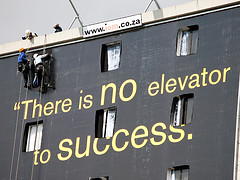
No Elevator To SuccessMichael Jordan can beat you at a game of basketball without trying. Donald Trump can find a better real estate deal than you with just a few calls. Jeremy Schoemaker can make money on a web site faster than you with minimal effort (and get other people to promote for him for free). Skellie can get more subscribers for a new site in just 5 days than you can in a year of trying. So how do they do it? Why is it so easy for them? The answer is they built a machine.

In this article I’ll outline how you can build your own machine. The concepts are simple but the results are long reaching. Building the machine may require hard work to create a foundation, but once it’s built you can achieve success without really trying. Follow the four rules below and your machine will give you long term, self-perpetuating success.

Long Term

Is Trump smarter than you? Maybe, maybe not. But his machine is certainly better than yours for making real estate deals. Trump’s machine has many industry contacts to get him the right deals. It has his knowledge in evaluating deals. It has his financial backers allowing him to move on his deals. His machine has many parts to it that allow him to succeed almost automatically.

A machine is different than an experience. It’s built to have long term results. I may have bought a house once and certainly would have some knowledge of buying a house but I’m not setup to do deals consistently. It’s more than just being smart- anyone can take the time to read a book to get the essentials of success. It’s about building a foundation. It’s building the bank relationships. It’s building the industry relationships. It’s building a track record to make people want to invest in you. It’s building a staff that knows what needs to be done. It’s the mind set that this will be done more than once, so I should plan accordingly and not just get it done.

Quality

The Trump example doesn’t mean that you need to be big to build a machine. Being big can actually be detrimental if you don’t have your machine under control. Let’s take Skellie for example. Does she have a big organization behind her? No. Is Skellie a better writer than you? Probably, but not necessarily. She may be a good writer but there are probably a number of blogs that are better written than hers that don’t receive the attention she gets (I don’t have examples because those blogs don’t get attention so I haven’t seen them). So what is it that makes Skellie able to launch a site and instantaneously attract 1000 subscribers? It’s her machine of course. Her machine is her ability to use her creative talents and harness loyal readers. Her machine includes the loyal readers she built up at Skelliewag. It includes her contacts with other bloggers. You get the idea.

Building a machine requires a commitment to quality otherwise your machine will work against you and create problems instead of solutions. Success requires that you solve the problem. That you create a process to ensure quality. That you review your open commitments so items don’t slip. A well built machine does the same thing over and over again.

Skellie didn’t take shortcuts by sacrificing quality in her content. Quality takes constant introspection and improvements. For example, Skellie batches her writing to one day a week (in advance) and has a system to deal with writer’s block. Skellie has found the way to keep creating quality content and her machine helps her achieve success.

Self-Perpetuating

How does Paris Hilton have the resources to continue her escapades? Simple, she’s an heiress to the Hilton fortune. The money in her trust is her machine. The money that built her nest egg just keeps earning more money with little effort. Some people are lucky enough to take advantage of other people’s machines.

A machine simplifies a process and makes success self-perpetuating. It provides a road map to the future and provides the tools to get there faster. This is what makes Success Making Machine special. It’s not merely a few helpful tips, it’s something you can build on.

Enjoy It

Even when I’m old and grey, I won’t be able to play it, but I’ll still love the game.
Michael Jordan

I’ve always told people that to be successful you have to enjoy what you’re doing and right now I really enjoy what I’m doing. I’m having too much fun with my life. Why would I want to do something else? Why would I want to run for governor?
Donald Trump

Enjoy your work and you’ll never work a day in your life. If you asked Trump or Jordan to do what they do for free, they would. With dedication like that it’s no wonder they overcame the obstacles in their way.

You can build your machine to eliminate the tasks you don’t like. Machines can do the heavy lifting. I’m sure Trump isn’t interested in the nitty gritty of making his deal more tax effective, but people in his machine take care of that for him. Always enjoy the journey.

The Right Way to Build a Machine
Building a machine is a conscious decision to create a quality focused, automated system for the long term for something you enjoy. Using these principles helps you realize your efforts today can have huge long term ramifications that can improve your life. Once your machine is built you can just live on the interest- without really trying.

What kind of machine do you want to build?


Next step

Think about your goals. How can you make a quality machine that self-perpetuating built for the long term?

Now, look at the principles to building your machine.

Photo by: Coda

The Two Ear Rule To Success

Not listeningRecently Sara contacted me off-line she wanted to subscribe to my site but got gibberish. I tried to explain that when she clicked on my subscribe link she got information to subscribe to my RSS link. The response was “what’s that?” With more explanations I got more questions. A long conversation ensued and I ended up helping her subscribe via email- her preferred way to keep up.

I was thinking about this episode and was surprised that she didn’t know what RSS was- most sites only give a subscribe link to their RSS feed. “This isn’t so complicated” I thought. Then I thought of the advice my mother once told me: “People have two ears and one mouth, so we should listen twice as much as we speak”. I was talking too much in that conversation. I realized that these technologies are recent innovations and aren’t common knowledge. The inability to subscribe may be happening to many people. Not everyone knows RSS, Feedburner and Google Reader and they shouldn’t have to just to read my site.

As a result I introduced a subscribe page. It’s not elegant but it starts pointing people in the right direction. Another example of layering in action. It’s a lot easier to make it easy for them and give instructions than to have phone calls and explain this one.

Are you expecting too much knowledge from your customers? Are you talking more than listening? Make it easy for them to start with you and even easier to stay with you.

photo credit: twenty_questions

How To Act Like a President, The Seven Year Lesson From Jay Chiat

During the high flying days of the first internet revolution I worked for a public dot com. The chairman was Jay Chiat the legendary ad man who co-founded Chiat, Day. He was the advertising genius behind many campaigns including Apple’s 1984 commercial which some say transformed the Super Bowl into the advertising event it has become. I only worked with Jay (everyone was called by their first name- it was a dot com after all)  a few times. But once, a month into my tenure as a freshly minted MBA, during an informal chat on the way back from the men’s room he made a huge impression on me.

We were talking and then he paused, crossed over to my side, bent down to picked up a small piece of paper (which I didn’t notice) and threw it out. Then he continued the conversation as if nothing happened. This act left me puzzled for over 7 years. I couldn’t understand it and theorized he was just a very clean person and this bothered him. Or maybe he was trying to make a statement- every piece of paper out of order is important- let’s portray a positive image. Or maybe his statement was that even a famous chairman like him is involved in the mundane day to day tasks.

Fast forward 7 years. I was walking back to my desk saw a little piece of paper in the hallway next to someone else’s desk, I bent down and threw it out. After I realized what I had instinctively done I started thinking about why I did it and remembered the story with Chiat those years earlier. Then it hit me, I did it because I felt responsible for the company. At the dot com I worked hard and felt responsible for my projects and surroundings, but didn’t feel as responsible for the company (even though I had stock options). At this new company as a long time employee and manager I felt a sense of ownership on the company’s success (though I wasn’t an owner). That’s probably why Chiat did it.

The lesson is simple. Act like the president of whatever company or task you’re working on. Instill in your employees a sense of ownership. Instill it in your kids. They will work
for their own pride harder than they would work for someone else’s. The way to do it is to give more responsibility.

Six Reasons You Should Layer Your Projects

Success on a project, in business or in life can’t be achieved until you start. Layering is an approach that increases your chance for success.

The concept is simple:

  1. Break the project into small parts
  2. Launch
  3. Repeat this process with more layers of complexity

The power of layering is easy to see below.

Show results– Layering allows you to see results from your actions quickly. This will help get more buy in and give you the confidence to succeed.

Benefit from the results– You can begin benefiting from work work quickly. You don’t need to wait for the whole project to be completed.

Learn from success and failures– You can learn from the feedback of your launch and it can help set the direction of further phases of your project.

Helps determine priories– After you launch a layer the next need will become more obvious.

Determines the project’s viability– Once you get your feet wet on the project you may find that the project is more complex that originally thought and it may not be worth it to continue. This helps you cut your losses.

Doesn’t get bogged down in details– The longer a project continues the more likely it will get held up for small details. Layering may allow you to launch without the details fully developed and then you address it in a future launch.

As you can see there are huge benefits to layering. Layering is one of the principles of building your success- you can read more about it, including examples how to use it, at the Layering Page .

Getting Dreams Done Part 1: Making Dreams Reality

What’s stopping you from achieving your dreams? For many people it’s simple, they haven’t verbalized their dreams. Without verbalization, dreams can’t happen. Others will fire back the usual dream, “I want to be rich and happy”. Having a dream is a step in the right direction but if you haven’t turned your dreams into actionable items and pursued it, that’s what it will remain- a dream but not reality. So how can you turn a dream into reality? There are 4 easy steps: verbalize the dream, set your goals, create a plan to turn that dream into reality and of course execute. In this part we will focus on verbalizing the dream.

Determining Your Dreams

One of the key points of the Success Making Machine (and how it enhances GTD) is that you are encouraged, dare I say required, to verbalize your dreams. In the dream phase you are picturing what success looks like. At this point, you can make them as unrealistic as you want or as generic as you want, even “I want to be rich and happy”. The more specific you are the more it will help you in the long run. One way to put some structure around your dreams is to verbalize dreams for each area of your life: career, financial, family, social, community, health etc .

Be Positive

When you are verbalizing your dreams- focus on what you want, not what you don’t want. For example, “I want to be rich” is more powerful than “I don’t want to be poor”.

Before you commit to a dream ask yourself if it’s really what you want. Picture your life with your dream achieved. You may find that it isn’t quite what you want. Growing up, many of us wanted to be sports/music or film stars. If you had the magic powers to have the talent for it would you still want it? Maybe you wanted the fun that went with being a baseball player but do you really want to play every single day for 10-20 years? Perhaps you may want it but do you want to keep up that rigorous travel schedule? How will this correspond with your goal of raising a family? So before you commit- think it through.

Buy into your dream

A dream should be something you truly want. Then set your energies to it. Your thoughts, beliefs and actions should be geared toward achieving this goal. You’ll need to believe this dream is possible. You don’t need to know all the details of how it will happen- just know that it will. As you continue to read through this series some of the next steps to success will crystallize. Some would call this the “Law of Attraction” (if you believe/act a certain way you will attract it). This site isn’t build on going into psychological tricks and unproven theories- it’s about logic and actions. Logic tells you if you believe something, invest yourself in it and your mind works toward achieving it, you will be more likely to succeed. You can call it karma- I’ll call it logic.

The Finale

Peter at I will change your life(which I recommend) has a well defined dream:

…to write a book that would help young people, or anyone really, find happiness and meaning in their life…

In the final part in this series I will outline how to use the lessons from this series to approach his dream.

What’s your dream?

Verbalize it and you’ll get closer to achieving it. Now that you’ve started to crystallize your dreams, in the next section we’ll talk about taking steps to achieve it. Subscribe to this feed to be notified when the next part of this series is posted.

8 Ways To Do Less Of What You Don’t Like

Readers of this blog know that being more successful can be easy and fun- all you have to do is follow The Rule of Thumb for Success: do more of what you like and less of what you don’t like. Today we’ll concentrate on doing less of what you don’t like using techniques you already know.

Identify Your Tasks That You Don’t Like
The first step in any en devour is to figure out what you’re trying to accomplish. During the course of your day there will be numerous tasks that will annoy you, cause you to pull out your hair or that you simply don’t like. Identify them- they are now put on notice. Pick a few items you will work on eliminating. I suggest you start with a few easy ones so you can see quick results (see layering). Once you get the hang of it go for the really annoying ones that may be harder to eliminate.

Eat the Tasks You Don’t like
Now that you know what you want to accomplish it’s time to plan how to do it. I recommend you Ate your task- By ATE I mean eliminATE, delegATE or automATE. Below I’ll explain the concepts and show you how you can use it. To better illustrate the power of these techniques I’ll give you specific examples using everyone’s least favorite task: washing dishes.

Eliminate

  • Decide– Decide that you don’t want to do it. It could be it’s not needed or it’s not that important anymore. If you’re doing the task for someone else ask them if they still need it. If you’re too chicken to ask your boss if he still needs that monthly report, just ask him if you can enhance it or make it better in any way. Perhaps you know of a different report that will do the job better.

Lets see how to use this to do fewer dishes: Decide you don’t want to do dishes anymore and switch to plastic (at least for really mess stuff). Decide that you don’t want to bake anymore.

  • Combine– Combine the task you dislike with something else you like. People often combine exercise with TV. Before they know it they’ve run another mile. Be sure that the tasks are compatible (e.g. no tv and washing dishes because your eyes cant do both at the same time) and that you don’t multi-task. You need to give each task the appropriate attention.

Do fewer dishes: Use dishes time as quality time with your partner. You are going to talk about your days (at least you should) and discuss future plans you may as well get something accomplished at the same time. He can even dry.

  • Simplify– Try not to over complicate the process- that may be leading to your dislike. Try to isolate the parts you don’t like doing and find a solution for that.

Do fewer dishes: Eat out/Order in. The goal is to eat- not to cook. If you don’t cook, there are no dishes. If your issue with washing dishes is that your hands get too dry be sure to have gloves handy and that will eliminate your problems.

  • Batch it– Do multiple tasks together and save setup time. It will also limit your dislike time to a small portion of the day.

Do fewer dishes: Don’t wash a dish at a time, wash them all together.

Delegate

  • Insource– See who within your organization (or family) you can get to do the horrid task. Offer to trade tasks or even bribe them. If you don’t have people capable train them. You may think it takes a while to train but it can pay huge dividends in the future.

Do fewer dishes: Trade tasks with your partner- you take care of the kids if she’ll wash the dishes.

  • Outsource– Pay someone to do it. You can find personal assistants for virtually anything. It may be expensive but you may decide to skimp on your budget elsewhere or put in extra hours just to afford the luxury.

Do fewer dishes: Hire help.

Automate

  • Automate the process– Look to computers and other technology to take care of the task for you. It may take an investment of time or effort but often can lead to huge dividends.

Do fewer dishes: Get a dishwasher.

  • Habits– Set habits for yourself that will make your job easier. You can try to set habits for others to.

Do fewer dishes: Annoyed that your kids don’t bring the dishes? Have a candy dish at the sink. When dishes are deposited then they get to take an item. Replenish it quickly at first and then less in the future until it becomes second nature.

Bonus

Sometimes there are tasks that you just have to do so try to make it more fun. Add music to it. Do it in a fun way (splash the water). Remember it’s not work if you want to do it.

At Seth’s Blog he calls our rule of thumb for success: Have to vs. Get to. Wouldn’t it be great if you get to do what you have to do.

The Best Productivity System For You Guaranteed

Everyone has their own way of doing what it takes to be successful. Is your system better than mine? Or is mine better than yours? Maybe David’s way is better than both of ours? The answer to all three of these questions is undoubtedly “Yes”.

For you, your way is better. For me, my way is better etc. Lets face it, we all do things differently. We do things different because we are in different situations. You may have a home office and need to set up barriers not to let work into your home life and I may have be overwhelmed with email and dealing with that burden is my primary goal.

No matter how well we do things our system is not perfect. This is why you’re reading and trying to get tips to improve yourself- to be more productive. I’m here to find common ground to see where we agree (or should agree)- there are certain fundamentals for success.

My goal on this site is to identify the fundamentals (roadmap and tools) to achieving success. Then you can choose how you want to implement it. You already perform many of the fundamentals yourself but we need to organize it so that we dont need to think about what’s next. Identifying a roadmap will give you a way to tackle any project. The tools will help you get there faster.

The key to any project is to start with basic building blocks: Think, Do, Enjoy. In short:

  • Think before you do something.
  • Do- Do it the best way you can.
  • Enjoy it- gives motivation and meaning to what needs to be done

There’s much more to each of those phases, but I’ve only introduced you to the basics, which you can already apply. The key is to start small- you can’t make a radical change overnight. Building your success machine will take time. You need to take on one task at a time execute it well and gradually take on more as you integrate this into your life. This process is called layering: you start with one success and build on it. Now you’ve just added a new tool to your success tool box (I’m sure you always had it but it never had a name). Next time you have a large project you’ll take the time to think first- how can I break this down into smaller parts. How can I get something done? Pretty soon you’ll be a pro at layering and your productivity will soar.

Should you use an outlook/palm combination or is it a gmail/remember the milk combination to track your to dos? That’s up to you. If i take you out of your comfort zone you wont listen to even the best system. The key to getting more productive and successful is taking it one step at a time.

The best system for you is the one that works for you. Look around here, read Getting Things Done, read other blogs take the best ideas and implement them in your life. Then you’re guaranteed to increase your chance for success.

Review It Like You Mean It and You’ll Accomplish More

For many people the weekly review is a chore- it gets in the way of doing real stuff and there’s no time- if they do it at all. Below is a way to make you’re weekly review more rewarding and allow you to accomplish more.

First avoid clutter in your review. Just review your next actions and projects. LifeHack recently had an interesting article 12 Ways to Upgrade Your Weekly Review. They mention many important elements but if you’ve turned your dreams into goals and thus actionable plans most of the reviews suggested aren’t necessary. They are on your to do list/ projects: Health, social, financial etc.

On the other hand it is important to do an optimization and productivity review. They will keep you working optimally. That’s where the Accomplishment Review comes in. It will encompass the optimization and productivity review and will be fun to do. It also gives you something solid to base your ideas off- your completed projects.

The Accomplishment Review is when you look over your completed tasks over the last week. Take pride in all you’ve done and see where you can improve by adding efficiencies. This will give you more enjoyment and motivate you in the future.

Next Action: Incorporate the accomplishment review into your review this week. Report back what you learned.

How Layering Helped This Site Launch Quickly and Can Help Your Projects

Completing a large project is difficult. You can go through a phase of requirement gathering, analysis and sign offs and still not anticipate everything that can go wrong. Plus the more time you spend on analysis the more likely the need changes. This is why large projects fail so frequently. The solution is Layering. The concept is simple: break the project into small parts, start small and “launch” frequently. Then add more layers of complexity on it. The advantage of layering is that you can see results quickly and adjust your plan to make your project more successful.

After identifying the desire to start this site I realized it would take months to set up and gather all the required content. That’s a long time. The solution: launch quickly and often. Using the layering technique I did.

1. Identify the Goal
Every project must have a clear goal- if you don’t know where you’re going how do you know when you get there. The goal was to launch a site that conveys the best methodology to achieve success.

2. Start small
I determined the first step is to get a site up, outline the system and start explaining each of the concepts one at a time. If I would have waited to write all the content for all sections to explain the whole system it would have taken a long time. Further, I wouldn’t be getting feedback from my readers along the way on tweaking the content. So this concept will actually make my end product better. I registered the domain and used blogger to get started.

3. Get better
I started adding some more content and filled out categories. But I soon realized that although blogger is good for blogging it’s not good for organizing information. The kind of information information needs a different tool. I evaluated Content Management Systems and decided on Joomla which I had used previously.

4. Tweak it
I tweaked the home page and site organization to make it easier to understand. I’ve added a Get Started page to make it easier to adopt the system. Then I added a game section to house all the fun exercises to teach the system.

5. Keep Layering
I keep adding more blog posts. Then I transform some of the small ideas from a post to the big idea for an article about the principles. I’ve come to a stable stage now, but i know that one day i’ll want to change my look and add logos and branding. But that isn’t important now as I’m building content and a community. So I’ll layer that later.

If you’ve noticed that some items in the blue print and principles aren’t built out yet, now you know why. Come back soon and they will be.