Most teams are familiar with the traditional daily stand-up. It is a short meeting designed to keep everyone connected around three basic questions:
What did I do? What am I doing next? What’s blocking me?
That structure is useful. It creates visibility, accountability, and a regular team rhythm. But you can do better.
The Golden Stand-Up builds on that foundation. It takes the stand-up beyond sharing status and turns those few minutes together into an opportunity to accelerate execution.
Show, Don’t Tell
Instead of simply saying what you worked on, show it whenever possible. Open the application. Demonstrate the feature. Pull up the report. Walk through the process.
Seeing the actual work creates shared understanding and allows feedback and course correction to happen early, while changes are still easy to make.
Make Decisions
The stand-up puts the team together every day. Use that opportunity.
When an issue needs a decision and the right people and information are available, make the decision. A question that can be resolved in two minutes shouldn’t unnecessarily sit for another day or become another meeting.
Create Quick Alignment
Projects lose time when people leave conversations with different understandings of the goal, requirement, priority, or next step.
The Golden Stand-Up provides a daily opportunity to recognize those differences and get everyone aligned before they become delays or rework.
Surface and Remove Blockers
A traditional stand-up asks, “What’s blocking you?”
The Golden Stand-Up adds the next question: “What are we going to do about it?”
Identify what is needed, determine who can help, and establish the next action.
Clarify Priorities and Dependencies
Priorities change. Work overlaps. One person’s task may depend on another person’s work.
The stand-up gives the team a regular opportunity to coordinate those dependencies and make sure everyone understands what matters most right now.
Leave With Clear Actions
The meeting should create action, not just conversation. Decisions have owners. Blockers have next steps. Questions have a path to resolution.
Keep It a Stand-Up
The Golden Stand-Up is not a replacement for project meetings or deeper working sessions. Decisions, alignment, and problem-solving during the stand-up should be limited to items that can be handled quickly.
When something requires a longer discussion, spin it out into a separate conversation immediately after the stand-up with only the people who need to be involved. This keeps the stand-up short while still ensuring the issue gets addressed.
The Difference
A traditional stand-up creates visibility into the work.
The Golden Stand-Up uses that visibility to accelerate the work.
It keeps the simplicity and cadence of the traditional stand-up while adding demonstration, decision-making, alignment, prioritization, and active problem-solving.
Don’t just report the work. Use the stand-up to advance it.
Most hiring discussions treat every position the same. Can we get away without hiring this person? If not, how do we get this employee the cheapest way?
But not all hires create value the same way, and because of that, they shouldn’t be evaluated, justified, or recruited the same way.
As leverage increases, quality matters exponentially more.
A slightly better employee in some roles creates only slightly more value. A slightly better employee in other roles can create dramatically more value. Understanding that principle changes how we hire, develop, and organize people.
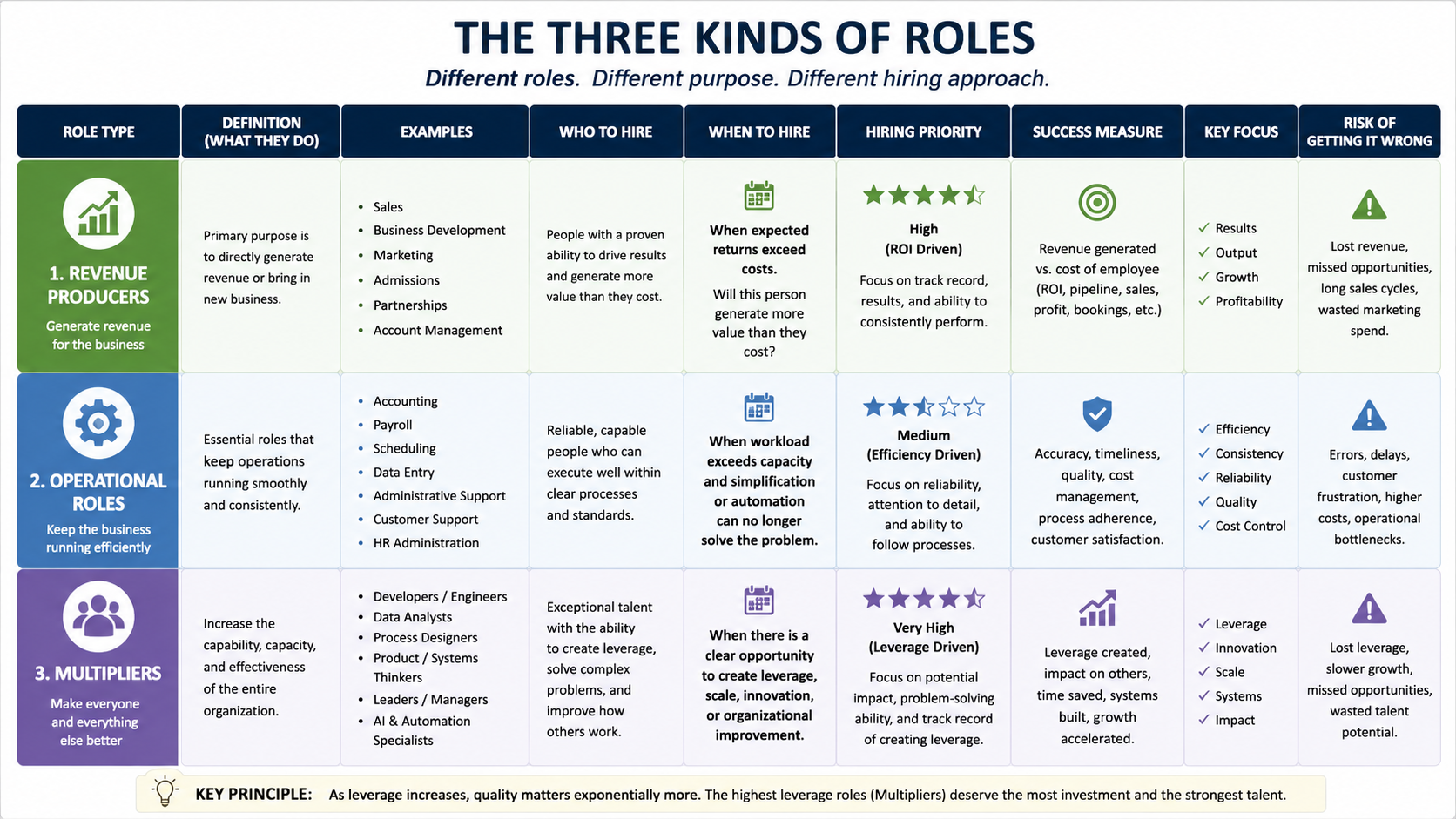
The Three Kinds of Roles
I’ve started thinking about employees in three broad categories:
1. Operational Roles
These are the roles required to keep the business functioning.
Accounting, payroll, scheduling, data entry, administrative support, and many operational positions fall into this category.
These roles are essential, but they typically don’t create exponential returns. Their purpose is consistency, reliability, and execution.
For these positions, the goal should often be:
Simplify the work
Standardize the process
Automate where possible
Reduce complexity
Hire capable people who can execute reliably
In these roles, spending twice as much for someone who is only marginally better rarely produces twice the value.
The leverage often comes from improving the system rather than upgrading the individual.
When to hire: when the workload exceeds capacity and simplification or automation can no longer solve the problem.
2. Revenue Producers
These are people whose primary purpose is to generate revenue.
Salespeople are the obvious example, but business development, marketing, admissions teams, and others may also fall into this category depending on the organization.
When to hire: Will this person generate more value than they cost?
If a salesperson costs $100,000 and reliably produces $500,000 in additional profit, the decision is easy.
The challenge isn’t whether to hire. The challenge is finding people who can consistently produce positive returns.
3. Multipliers
This is where things get interesting.
Multipliers are people who make everyone else better.
They create systems.
They automate work.
They redesign processes.
They solve problems that affect entire departments.
They introduce new technologies.
They discover better ways of operating.
A great developer can eliminate thousands of hours of manual work.
A great analyst can uncover opportunities nobody else sees.
A great leader can increase the productivity of an entire team.
These individuals don’t simply perform work.
They multiply work.
For these positions, paying more is often the cheapest option.
An average performer may cost 20% less while delivering 50% less value.
A great multiplier can create returns that dwarf their compensation.
When to hire: Hire when there is a clear opportunity to create leverage, scale, innovation, or organizational improvement.
The Employee Quality Dividend
As leverage increases, quality matters exponentially more.
As you see, depending on the role, quality can make a real difference. But there’s more to consider.
The Cheapest Employee Trap
We can see that hiring a “good enough” employee for multiplier roles limits the upside of the leverage of that role.
But the greater danger is often hidden.
The cost of an employee isn’t limited to salary and benefits.
A weak employee frequently consumes the time of stronger employees.
Managers spend more time reviewing work, answering questions, solving problems, handling escalations, and correcting mistakes. Senior employees become involved in issues that should have been handled elsewhere.
The result is a hidden tax on the organization’s best people.
This is especially dangerous when it affects multipliers. Every hour a multiplier spends compensating for poor performance is an hour they are not creating leverage, innovation, automation, or growth.
For high-leverage positions, the cost of hiring the wrong person is often far greater than the cost of paying more for the right one.
In these situations, the cheapest employee can become the most expensive employee.
The AI Effect
Artificial intelligence makes this role distinction even more important.
AI increasingly handles routine work.
The future value of many operational roles will come from how effectively people use systems rather than perform manual tasks.
At the same time, AI dramatically increases the power of multipliers.
A talented employee with AI can often accomplish what previously required multiple people.
The gap between average performers and high-leverage performers may become larger than it has ever been.
This doesn’t mean every employee needs to be an AI expert.
It does mean that for multiplier roles, AI fluency is rapidly becoming a force multiplier on top of a force multiplier. This should be required.
One Great Person vs. Two Average People
Organizations often assume that more people equals more output.
That isn’t always true.
One highly capable person may outperform two average employees while requiring:
Less management
Less coordination
Fewer meetings
Less communication overhead
Faster decision making
The value isn’t just in what they produce.
It’s also in the friction they eliminate.
Conclusion: The quality of the employee matters more as the leverage of the role increases.
The Multiplying Organization
The goal isn’t simply to hire great people.
The goal is to build an organization where:
Routine work is simplified.
Operational work is standardized.
Revenue generation is expanded.
Multipliers are unleashed.
When we simplify the basics, we free resources for innovation.
Enhance your multipliers
When we automate repetitive work, we create capacity for higher-value work.
But once employees are hired there’s more to be done to put them in the best position to leverage their skills:
Create a culture of training and development that is personalized to each employee.
Separate multiplier work from operational work. When possible, take non-multiplier work and operationalize it so it can be handled by an operational role.
Protect multiplier time. Because they’re good, they’ll often be pulled into unnecessary tasks. Protect them.
Finding Multipliers Already Inside the Organization
Not every multiplier needs to be hired.
Some of the best multiplier opportunities already exist within the organization.
Employees who deeply understand the business can often become analysts, leaders, trainers, process designers, or AI power users when given the right tools and development.
Before searching externally, organizations should ask:
“Do we already have someone with the potential to create greater leverage?”
Developing internal talent is often less risky than hiring externally and can create stronger engagement, retention, and institutional knowledge.
Multipliers Create Multipliers
The highest-leverage employees don’t simply produce more output.
They increase the capability of everyone around them.
They create systems that others use.
They develop future leaders.
They teach best practices.
They establish standards.
They make entire teams more effective.
Their impact continues long after their individual work is complete.
The ultimate multiplier is someone whose influence remains even when they are not in the room.
The more multipliers you have the more culture changes.
Conclusion
When we place great people in high-leverage roles, their impact compounds throughout the organization.
The question is no longer:
“Do we need another employee?”
The better question is:
“What type of employee do we need, and what return should we expect from that investment?”
Once we answer that, hiring becomes less about filling seats and more about building a stronger organization.
Key Takeaways
Before hiring, first ask whether the problem can be solved through process improvement, simplification, or automation.
Not all positions should be hired, evaluated, or recruited the same way.
Multipliers deserve disproportionate attention because they can create value far beyond their individual output.
The quality of the employee matters more as the leverage of the role increases.
Most organizations don’t struggle because they lack smart people or modern tools. They struggle because they lack a shared understanding of what’s actually broken.
You’ve seen it:
The dashboard says one thing, the team says another or simply ignore it.
Projects “make progress” but don’t land.
Meetings are sharp, follow-through is soft.
A process “exists,” but everyone runs it differently.
Someone says “we need tech to fix this”, but cant define what this is
The problem is we use one word—maturity—to describe two different things.
This model is needed because it separates them.
The Organizational Maturity Model: Capability + Process
1) Capability Maturity (skills-first)
How well a person or team turns information into judgment and action. This applies to individuals and organizations. Tech may support it, but it’s not “a tech ladder.”
2) Process Maturity
How clearly the work is defined, repeatable, measurable, and improvable.
The Organizational Maturity Grid: Diagnosing Your Next Growth Move
Ladder 1: Capability Maturity
C0 — Tribal memory Depends on what people remember. C1 — Capture Notes/emails/paper. Information exists but isn’t reusable. C2 — Organize Spreadsheets/docs/checklists. Structure appears. C3 — Standardize Shared definitions, consistent metrics, repeatable reporting. C4 — Explore People can ask “why?” and investigate without rebuilding everything. This typically includes tools like Interactive views, drilldowns, slicing by context. C5 — Execute Decisions translate into owners, next steps, routing, follow-ups. Insights turn into action: alerts, routing, checklists, workflows, ownership. This typically includes shared plans and task lists. C6 — Learning Loop System Improves Itself. Outcomes feed back to refine standards, playbooks, and tooling (AI?). The goal is faster, higher-quality decisions with less cognitive load.
Ladder 2: Process Maturity
P0 — Ad hoc High variation. Lots of “it depends.” P1 — Repeatable There’s a usual way, but it’s not explicit. P2 — Defined Clear stages, handoffs, owners, and “done.” P3 — Measured Cycle time, aging, rework, defects, SLAs. P4 — Improved Experimentation and continuous improvement are normal.
Putting this together you get the Organizational Maturity Grid.
This grid gives you a targeted prescription:
Hero-Driven / High-Variance– Stabilize the process: define stages, ownership, and handoffs (raise P).
Bureaucratic Efficient– Invest in capability: definitions, analysis skills, and exploration habits (raise C).
After almost every interaction today, you get a survey. Buy something—survey. Call support—survey. Quick chat—survey.
We get so many that most people ignore them unless something goes wrong. And when something does go wrong, the scores are harsh. That creates a built-in bias: feedback skews negative by default.
But volume isn’t the real problem. What we ask is.
There Are Two Problems Hiding Under “Customer Service”
Customer service is really two separate things:
The service representative
The product or process itself
Most surveys focus almost entirely on the first.
They ask whether the rep was polite, followed a script, or “resolved” the issue. Sometimes that’s fair—training and enablement matter. But in many cases, the rep is just the messenger.
The real issue is usually upstream.
Support Calls Are Signals—If You Listen Correctly
Customers don’t call because they want to. They call because something is broken, confusing, or poorly designed.
Every call is a data point pointing to:
A flawed workflow
A confusing feature
A missing capability
Yet most surveys never capture this. Instead of learning why customers are frustrated, companies measure how well agents absorb that frustration.
That’s backwards.
Good customer service isn’t just handling problems well—it’s eliminating the reasons those problems exist.
Ask One Better Question
If you want useful feedback, stop asking ten shallow questions and ask one strong one.
Make it open-ended. Make it focused.
The question we use on our intranet is:
“What is the ONE thing that would most improve your experience with [Intranet Name]?”
The phrase “the ONE thing” forces clarity. You get fewer answers—but better ones. And they point directly to where time and energy should be spent.
Try it.
One Last Thing: Be Fair to Your Support Team
When customers do have a good interaction, reward it—clearly and consistently.
Service reps spend most of their time dealing with problems they didn’t create. They absorb frustration caused by broken products and bad processes, and they often get blamed for both.
If someone handled a bad situation well, give them a high grade. They earned it.
Fix the system. Listen better. And don’t punish the people stuck holding the bag.
Have you ever wondered why two equally skilled individuals can have drastically different efficiencies in solving the same problem? This question struck me as I observed various people working on SQL tasks. Remarkably, some completed the task in just 10 minutes, while others took up to 2 hours. Why such a disparity?
Interestingly, everyone in this group rated themselves 7 out of 10 in SQL proficiency. Certainly, some people might have misrated themselves, or used different scales. But even among those with similar knowledge levels, one major difference stood out – their approach to problem-solving. It’s fascinating how the approach, more than the skill level, dictates efficiency.
However, the right approach, honed through experience, can be a game-changer. By watching them, I’ve identified five key steps to streamline the learning curve and enhance efficiency in any endeavor, including SQL:
Focus on the Core: Start with the main thread or problem. In SQL, start with selecting the right table. Once you’ve done that, choosing fields and building your query becomes easier.
Leverage Available Tools: Utilize features like IntelliSense in SQL. This tool auto-completes field names and commands, saving time and reducing errors such as misspellings that can cause unnecessary delays.
Simplify Concepts: Start with using aliases in SQL. Instead of memorizing long table structures, use concise, meaningful aliases. For instance, ‘c’ for customers and ‘o’ for orders. This makes your code easier to read and remember.
Begin with Familiar Territory: Break down the problem and start with what you know. In SQL, begin with a single table and gradually incorporate additional tables as you build your query.
Validate Your Progress: Regularly check that you’re making positive progress. Execute your code often. This practice helps you stay on track and catch errors early, rather than revisiting and debugging later.
These steps, while tailored for SQL, can be universally applied to many other fields. The essence lies in taking a step back to assess and refine your approach. Whether it’s SQL or any other skill, the right strategy can dramatically improve your efficiency and output.
This observation goes beyond just coding; it’s about how we approach problems in our professional lives. A methodical, well-thought-out approach not only saves time but also enhances the quality of work. It’s a testament to the fact that experience isn’t just about knowing more; it’s about knowing the right approach.
In today’s tech-driven world, design is no longer just a visual element. It’s a powerful force that can make or break a company. Look at the iPhone’s fusion of artistry and innovation or Elon Musk’s visionary ideas in electric cars. Both are testaments to the significance of design.
But what happens when design is overlooked?
Let’s explore the real-world implications of design neglect, where one company’s flawed design decisions reveal a harsh truth: bad design can be the silent killer of companies.
A few years ago, my company selected a prominent HR software provider, a name synonymous with NBA jerseys and women’s soccer. On the surface, they seemed poised for success, having recently merged two major companies and with plans for product enhancement and cross-selling.
However, the problem lay in their design philosophy.
Instead of crafting a thoughtful design, they opted to amalgamate the “best of” their two existing apps. This decision proved disastrous for this type of software. It was akin to forcibly marrying two mismatched puzzle pieces, resulting in a disjointed and ill-fitting solution.
The repercussions of this design choice were profound:
Administrative Hassles: Managing two separate systems required administrators to learn and use both, introducing complexity and challenges during implementations.
Duplication of Infrastructure: Each system had its distinct code base, leading to the replication of reporting tools and APIs. This substantially increased the workload for users attempting to learn and implement them.
Support Challenges: Support personnel were restricted to working on one system, often leaving clients more knowledgeable than their own support staff. Resolving issues frequently necessitated the involvement of multiple personnel, resulting in extended response times.
Data Synchronization Problems: Data needed to flow between these systems, but there was no seamless way to synchronize it. The absence of synchronization led to a cascade of downstream issues.
Within the software company, problems escalated. Protracted support queues, lingering software glitches, and a revolving door of employees became the norm.
Despite its subpar design, the company won’t vanish overnight due to legacy clients and the complexities of transitioning HR systems. Nonetheless, I foresee a gradual exodus of clients as competitors with superior design or fresh alternatives gain momentum. Someday, they’ll reflect on their downward spiral and wonder where they went astray.
The answer will be glaringly evident: they fell victim to bad design.
This real-world example underscores the profound impact of design on a company’s destiny. It is a stark reminder that design isn’t confined to aesthetics alone; it profoundly influences functionality, efficiency, and user experience. Businesses that disregard structure do so at their peril, often succumbing to a gradual decline driven by poor decisions.
A few years ago, Google conducted a survey of its employees to determine what’s the main contributor to a high performing team. As I saw the headline I was intrigued to find out the result. I was sure leadership was the number one reason for team success- mostly because I was a manager and I had read a lot about the impact of good leadership. I read eagerly hoping to learn some tips. I even anticipated secondary reasons like: talent, team composition. But when I read the results I was shocked and disappointed by their conclusion- it did not include any of my assumptions. The research claimed that the #1 factor for high performing teams was “Psychological Safety” aka trust. It didn’t make sense to me. In general, I think people are good- especially in a professional environment. I thought in any reasonable organization people dont lie to each other, and are going to get paid on time. I really didn’t understand what this was trying to say- was it just some new fad?
A few months later I finally understood.
The company I worked for at the time had reorganized. Within a few weeks my team’s work quality started to suffer or so it seemed. Almost each time after we released a new update of the software to our operations team, there were issues. They were typically small and easy to fix but the issues escalated quickly. It went from the operations person who discovered the issue to their manager, to the VP, to the President of the company, to my boss (The CIO) and then it hit my desk as the VP in charge of that area. If you’re counting, that’s 7 steps. I knew where to go to get it fixed and involved an 8th person, Carla. She had recently switched from the operations department to my team in IT and understood the intersection between technology and operations well so was well suited for her new role. But it seems she started making a lot of mistakes all of a sudden. While the fixes were typically minor (e.g. change a number from 100 to 1000), each time I’d need to write up a full report on what happened, how it happened and how it was fixed etc and send it around the organization. It was very frustrating to say the least. Sometimes we needed to meet about it- wasting even more time. Of course I put in preventative steps to ensure that root cause wouldn’t happen again. I reviewed processes and put in more checks and balances. But the next time a different small issue would crop up and trigger a large chain of events. It was reflecting badly on the team, especially Carla as her mistakes came to light. As I worked to close gaps in the development/testing process, I tried to understand how quality tanked and so quickly. Finally in one discussion with Carla, she admitted that these mistakes were always happening. In the past her friend in the operations department would call her with the issue directly. They both came in early so they typically solved issues before others noticed. What had changed was that her friend moved to a different role. With new people in new roles in the organization no one reached across to solve issues and instead went up and down the chain. A small issue became a crisis.
When I rehashed this episode I realized that admitting mistakes early could have solved the issue early when Carla was starting out in her new role and saved countless hours of CYA emails and wasted meetings. Trust is important. Trust that a person won’t get in trouble for making a mistake. Trust to go across the organization. Trust that an issue is being taken care of appropriately. Trust that a manager will have appropriate solutions.
I realized I needed to do two things: first I had to make her comfortable enough to admit mistakes and gaps in knowledge so we can learn from it and prevent it from happening again. I also needed to give Carla more training. The problems soon went away and Carla succeeded in her role, but first came trust.
As I build a new team I know what I need to start with- Trust me.
Isn’t it crazy that we spend about half our day with people but we don’t get to choose them? This article is your chance to find out a little about what working on our team will be like.
The ideal teammate has good character, smarts, and initiative. We try not to get bogged down if a teammate shows up a little late sometimes or wants to leave early to go to their child’s game. Someone with good character would be courteous, communicate and not let it impact their work.
We try to add small twists to the mundane. When you’re asked if you have read this article, just tell us your favorite candy. Why do we care about your favorite treat? Because it’s the little things that make a work environment more interesting. If your favorite treat is waiting for you on your first day, that will get us started on the right foot.
We believe process and proper design are important. Henry Ford didn’t necessarily invent the best car- he invented the best process: the assembly line. Let’s work together to create the best plan to achieve the best results with the least effort.
We strive to create a culture of learning and hope that working together will be fulfilling. Lesson one: the secret to good communication is to get to the point and move on- Brevity.