Most hiring discussions treat every position the same. Can we get away without hiring this person? If not, how do we get this employee the cheapest way?
But not all hires create value the same way, and because of that, they shouldn’t be evaluated, justified, or recruited the same way.
As leverage increases, quality matters exponentially more.
A slightly better employee in some roles creates only slightly more value. A slightly better employee in other roles can create dramatically more value. Understanding that principle changes how we hire, develop, and organize people.
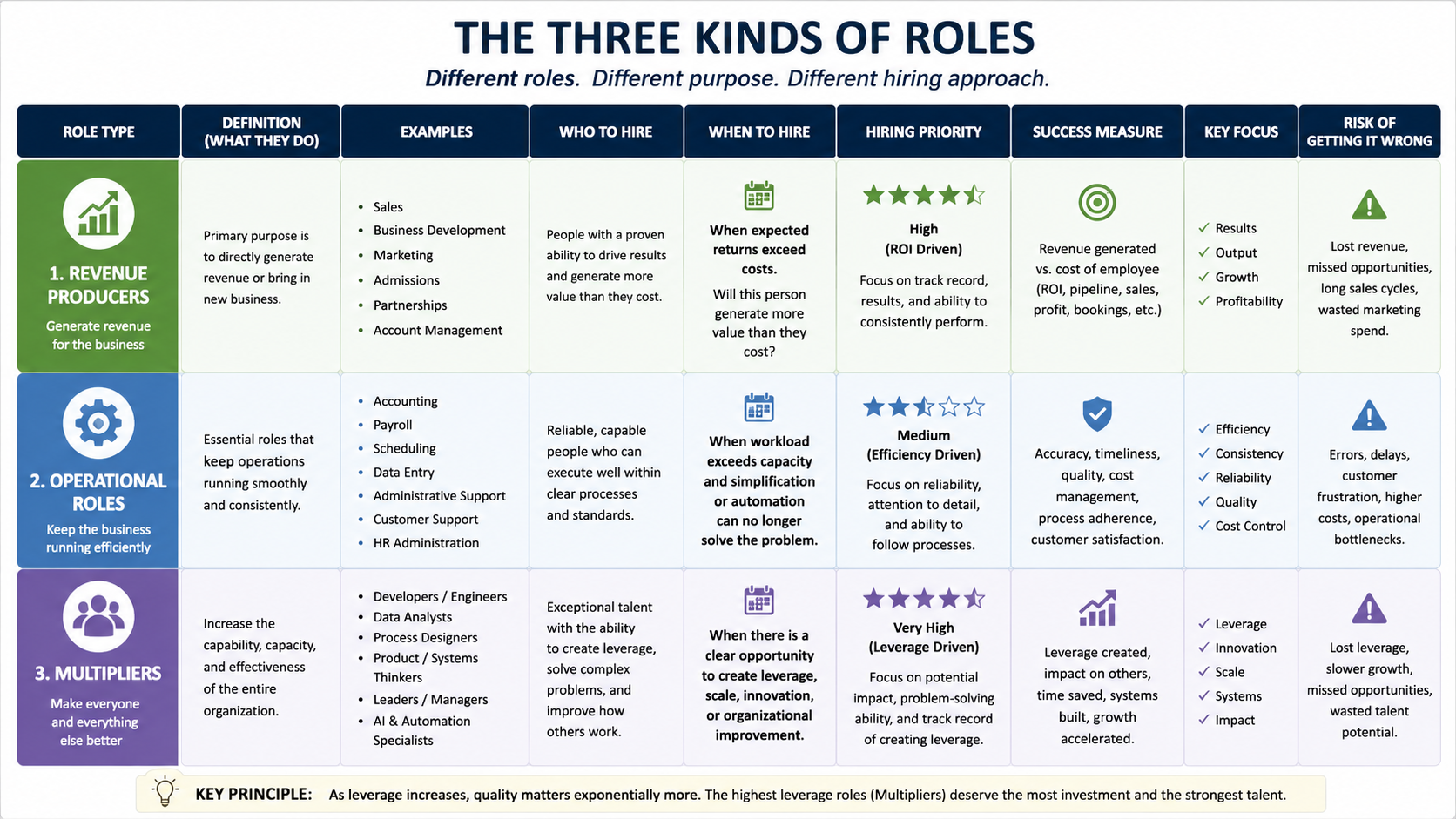
The Three Kinds of Roles
I’ve started thinking about employees in three broad categories:
1. Operational Roles
These are the roles required to keep the business functioning.
Accounting, payroll, scheduling, data entry, administrative support, and many operational positions fall into this category.
These roles are essential, but they typically don’t create exponential returns. Their purpose is consistency, reliability, and execution.
For these positions, the goal should often be:
- Simplify the work
- Standardize the process
- Automate where possible
- Reduce complexity
- Hire capable people who can execute reliably
In these roles, spending twice as much for someone who is only marginally better rarely produces twice the value.
The leverage often comes from improving the system rather than upgrading the individual.
When to hire: when the workload exceeds capacity and simplification or automation can no longer solve the problem.
2. Revenue Producers
These are people whose primary purpose is to generate revenue.
Salespeople are the obvious example, but business development, marketing, admissions teams, and others may also fall into this category depending on the organization.
When to hire: Will this person generate more value than they cost?
If a salesperson costs $100,000 and reliably produces $500,000 in additional profit, the decision is easy.
The challenge isn’t whether to hire. The challenge is finding people who can consistently produce positive returns.
3. Multipliers
This is where things get interesting.
Multipliers are people who make everyone else better.
They create systems.
They automate work.
They redesign processes.
They solve problems that affect entire departments.
They introduce new technologies.
They discover better ways of operating.
A great developer can eliminate thousands of hours of manual work.
A great analyst can uncover opportunities nobody else sees.
A great leader can increase the productivity of an entire team.
These individuals don’t simply perform work.
They multiply work.
For these positions, paying more is often the cheapest option.
An average performer may cost 20% less while delivering 50% less value.
A great multiplier can create returns that dwarf their compensation.
When to hire: Hire when there is a clear opportunity to create leverage, scale, innovation, or organizational improvement.
The Employee Quality Dividend
As leverage increases, quality matters exponentially more.
As you see, depending on the role, quality can make a real difference. But there’s more to consider.
The Cheapest Employee Trap
We can see that hiring a “good enough” employee for multiplier roles limits the upside of the leverage of that role.
But the greater danger is often hidden.
The cost of an employee isn’t limited to salary and benefits.
A weak employee frequently consumes the time of stronger employees.
Managers spend more time reviewing work, answering questions, solving problems, handling escalations, and correcting mistakes. Senior employees become involved in issues that should have been handled elsewhere.
The result is a hidden tax on the organization’s best people.
This is especially dangerous when it affects multipliers. Every hour a multiplier spends compensating for poor performance is an hour they are not creating leverage, innovation, automation, or growth.
For high-leverage positions, the cost of hiring the wrong person is often far greater than the cost of paying more for the right one.
In these situations, the cheapest employee can become the most expensive employee.
The AI Effect
Artificial intelligence makes this role distinction even more important.
AI increasingly handles routine work.
The future value of many operational roles will come from how effectively people use systems rather than perform manual tasks.
At the same time, AI dramatically increases the power of multipliers.
A talented employee with AI can often accomplish what previously required multiple people.
The gap between average performers and high-leverage performers may become larger than it has ever been.
This doesn’t mean every employee needs to be an AI expert.
It does mean that for multiplier roles, AI fluency is rapidly becoming a force multiplier on top of a force multiplier. This should be required.
One Great Person vs. Two Average People
Organizations often assume that more people equals more output.
That isn’t always true.
One highly capable person may outperform two average employees while requiring:
- Less management
- Less coordination
- Fewer meetings
- Less communication overhead
- Faster decision making
The value isn’t just in what they produce.
It’s also in the friction they eliminate.
Conclusion: The quality of the employee matters more as the leverage of the role increases.
The Multiplying Organization
The goal isn’t simply to hire great people.
The goal is to build an organization where:
- Routine work is simplified.
- Operational work is standardized.
- Revenue generation is expanded.
- Multipliers are unleashed.
When we simplify the basics, we free resources for innovation.
Enhance your multipliers
When we automate repetitive work, we create capacity for higher-value work.
But once employees are hired there’s more to be done to put them in the best position to leverage their skills:
- Create a culture of training and development that is personalized to each employee.
- Separate multiplier work from operational work. When possible, take non-multiplier work and operationalize it so it can be handled by an operational role.
- Protect multiplier time. Because they’re good, they’ll often be pulled into unnecessary tasks. Protect them.
Finding Multipliers Already Inside the Organization
Not every multiplier needs to be hired.
Some of the best multiplier opportunities already exist within the organization.
Employees who deeply understand the business can often become analysts, leaders, trainers, process designers, or AI power users when given the right tools and development.
Before searching externally, organizations should ask:
“Do we already have someone with the potential to create greater leverage?”
Developing internal talent is often less risky than hiring externally and can create stronger engagement, retention, and institutional knowledge.
Multipliers Create Multipliers
The highest-leverage employees don’t simply produce more output.
They increase the capability of everyone around them.
They create systems that others use.
They develop future leaders.
They teach best practices.
They establish standards.
They make entire teams more effective.
Their impact continues long after their individual work is complete.
The ultimate multiplier is someone whose influence remains even when they are not in the room.
The more multipliers you have the more culture changes.
Conclusion
When we place great people in high-leverage roles, their impact compounds throughout the organization.
The question is no longer:
“Do we need another employee?”
The better question is:
“What type of employee do we need, and what return should we expect from that investment?”
Once we answer that, hiring becomes less about filling seats and more about building a stronger organization.
Key Takeaways
- Before hiring, first ask whether the problem can be solved through process improvement, simplification, or automation.
- Not all positions should be hired, evaluated, or recruited the same way.
- Multipliers deserve disproportionate attention because they can create value far beyond their individual output.
- The quality of the employee matters more as the leverage of the role increases.
- There is a cost to quality but it is worth it